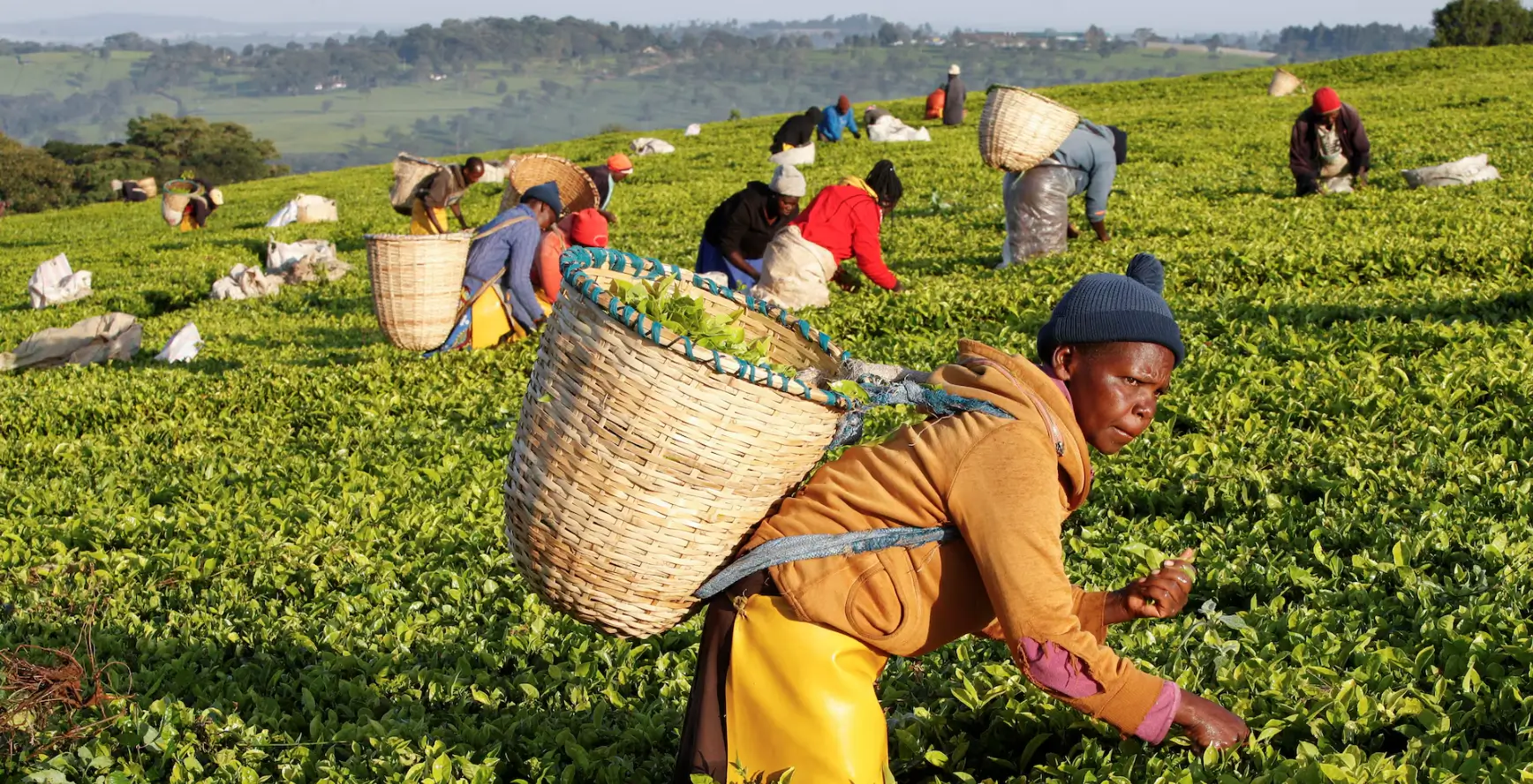
At the tea auction floor in Mombasa — the beating heart of Kenya's agricultural export economy — geopolitics is not an abstraction. It is a pricing factor. It determines which buyers show up, how much they are willing to spend, and, increasingly, whether they can show up at all. A cascade of overlapping global conflicts is now threatening one of Kenya's most vital export industries, exposing the structural vulnerabilities of a sector heavily dependent on a handful of markets that are themselves caught in the fires of war, economic sanctions, and diplomatic disputes.
Kenya is the world's largest exporter of black CTC (Crush, Tear, Curl) tea and consistently ranks among the top three tea exporters globally by volume. Tea is the country's leading agricultural export and a cornerstone of rural incomes for hundreds of thousands of smallholder farmers. In November 2025, the country exported 52.38 million kilograms of tea — up nearly 12% from the same month a year earlier — a figure that reflects both the industry's resilience and its growing exposure to external shocks.
Yet behind that headline growth lies a more troubling picture. The ten destinations that collectively account for 82.7% of Kenya's monthly tea exports now read less like a trade ledger and more like a maritime risk assessment map — nations sitting in, adjacent to, or economically entangled with some of the world's most active conflict zones.
The Export Map: A Concentration Risk
Kenya's tea export base is geographically concentrated to a degree that would alarm any risk manager. In November 2025, Pakistan alone absorbed 21.14 million kilograms of Kenyan tea — just over 40% of total exports for that month, making it by far the single largest buyer. Behind Pakistan came Egypt (5.15 million kg), the United Kingdom (5.14 million kg), Russia (2.87 million kg), and Kazakhstan (2.64 million kg). Rounding out the top ten were the United Arab Emirates (UAE), Yemen, India, Iran, and Oman.
The concentration of trade in so few markets is itself a structural vulnerability. But what makes the current situation especially acute is that many of these top buyers are simultaneously embroiled in, or economically exposed to, active geopolitical conflicts. For Kenya's tea sector, the risk is not theoretical — it is unfolding in real time, in the shipping lanes, currency markets, and diplomatic channels that connect Nairobi's tea gardens to teacups across Asia and the Middle East.
The Gulf in Flames: Iran, the UAE, and the Strait of Hormuz
Iran's widening confrontation with regional rivals represents one of the most direct threats to Kenyan tea exports. Tehran's actions have included strikes beyond its own borders and explicit threats to disrupt shipping in the Strait of Hormuz — a narrow waterway through which approximately 20% of global oil trade passes. Even without a full closure, the risk premium on vessels entering or exiting the Gulf has risen sharply. For Kenyan tea exporters, that translates into higher freight charges, steeper insurance premiums, and longer transit times as shipping lines recalculate routes.
Iran itself was, until recently, a mega-consumer of Kenyan tea and one of the country's most valuable export markets. That changed abruptly in 2024, when Tehran suspended Kenyan tea imports following allegations that imported tea leaves were misrepresented and that foreign currency payments were misappropriated. The suspension cut off roughly 86% of shipments to Iran — an enormous blow to the sector. Negotiations to reopen the market remain in limbo, complicated further by the ongoing military pressure from joint Israeli and US strikes that have continued to destabilise Iran's political foundation. Hundreds of Kenyan smallholder farmers are caught in the uncertainty, unable to plan for the season ahead.
The United Arab Emirates compounds the problem further. The UAE is not merely a direct buyer of Kenyan tea; it also functions as a critical re-export hub through which cargo is redistributed across the Middle East and Central Asia. When Dubai is disrupted, the ripple effects travel outward across the entire regional supply chain. In the wake of the killing of senior Iranian political and military figures — including the Supreme Leader Ayatollah Khamenei — Tehran directed significant retaliatory pressure toward Dubai, threatening the financial and logistical networks that sit at the centre of regional trade.
Yemen and the Red Sea Corridor
Further south, instability around the Red Sea compounds the threat to Kenyan exports. Yemen, which imported 1.57 million kilograms of Kenyan tea in November 2025 — a dramatic year-on-year surge from just 284,914 kilograms in the same month the previous year — sits astride one of the world's most sensitive maritime corridors.
Shipping lines wary of missile and drone attacks from Iran-supported Houthi forces have already rerouted a significant number of vessels around the Cape of Good Hope, bypassing the Red Sea and Suez Canal entirely. That adds weeks to journeys and thousands of dollars in cost per container. Tea, though light in weight, travels in vast volumes, and the industry's margins are not immune to such arithmetic. For Kenyan exporters, higher shipping costs eat directly into profitability, and for buyers already facing currency pressures or economic strain, higher landed costs can dampen demand.
Pakistan and Afghanistan: The Eastern Front
The gravest single vulnerability in Kenya's tea export network, however, lies to the east. Pakistan — the country's dominant tea buyer — is now engaged in open hostilities with Afghanistan. Cross-border airstrikes and artillery exchanges have pushed the two neighbours into their most serious confrontation in years. Even before the fighting intensified, Pakistan's economy was under significant pressure: burdened by high debt, a fragile currency, and an ongoing IMF adjustment programme. War will heighten currency pressure, fiscal strain, and the risk of disruption to port and transport infrastructure.
Given that Pakistan accounts for more than 40% of Kenya's total tea exports, even a modest slowdown in Pakistani consumption — or difficulty in settling import bills due to banking disruptions or foreign exchange constraints — would be felt immediately on the auction floors in Mombasa. Tea prices, buyer confidence, and the livelihoods of thousands of Kenyan farmers are all tethered, whether they know it or not, to the political and economic stability of Islamabad.
Afghanistan, though a smaller direct buyer of Kenyan tea, has historically imported significant volumes — often routed through regional trade corridors that pass through or near Pakistan. Conflict along the Pakistan–Afghanistan border complicates those corridors directly. Formal trade can stall; informal flows may proliferate; but payments become harder to trace, insure, and process through compliant banking systems.
Egypt, Russia, and Kazakhstan: Slower-Burning Pressures
Beyond the active conflict zones, several other top buyers are grappling with structural economic pressures that carry their own risks for Kenyan exporters. Egypt, Kenya's second-largest tea export destination in November 2025, faces acute economic difficulties: a currency that has repeatedly come under pressure, an elevated import bill, and exposure to higher shipping costs if disruption in the Suez Canal corridor forces alternative routing. A weakened Egyptian pound reduces the purchasing power of Egyptian tea importers, even when their demand for the product remains strong.
Russia and Kazakhstan, which together absorbed over five million kilograms of Kenyan tea in November 2025, are enmeshed in the broader geopolitical tensions stemming from the war in Ukraine. International sanctions regimes and the isolation of Russian financial institutions from mainstream global banking infrastructure complicate trade finance and payment settlement. For Kenyan exporters doing business with buyers in these markets, the administrative and legal complexity of compliant transactions has grown considerably.
Sudan: A Diplomatic Wound
Closer to home, Kenya suffered a significant and self-inflicted blow to its tea export network when Sudan suspended Kenyan tea imports in March 2025. The ban was enacted amid a bitter diplomatic dispute over Kenya's engagement with Sudan's Rapid Support Forces (RSF) — the paramilitary group at the heart of the country's devastating civil war. The suspension lopped off one of Nairobi's historically significant tea export destinations, erasing millions in revenue from the sector.
Sudan remains embroiled in its civil conflict, with no peace process on the horizon and no active negotiations to resolve the bilateral diplomatic dispute with Kenya. The suspension of tea imports continues indefinitely, serving as a reminder that the threats to Kenya's tea sector are not only external — they can also arise from the country's own foreign policy choices and diplomatic postures.
Price Dynamics: A Double-Edged Threat
The economic consequences of this multi-front geopolitical exposure are not straightforward. In the short term, supply disruptions — whether from rerouted shipping, suspended markets, or reduced buyer capacity — can actually push Kenyan tea prices higher. When supply to end-consumers is constrained, buyers who remain in the market may bid more aggressively for available lots at the Mombasa auction.
Global tea prices currently hover around US$3 per kilogram — a figure that reflects competitive global supply but also the relatively inelastic nature of tea demand in the Middle East, where the beverage is a cultural staple. Short-term disruptions are unlikely to fundamentally alter consumption patterns in Pakistan, Egypt, or the Gulf.
However, prolonged instability in key markets carries the opposite risk. If buyers are squeezed out of the market for extended periods — by sanctions, currency collapse, war, or diplomatic suspension — the unsold supply begins to accumulate. A glut can form. Prices fall. And the farmers in Kenya's highlands, who have no control over any of these variables, absorb the consequences in their income.
The Diversification Imperative
In recognition of these structural vulnerabilities, Kenya has been actively pursuing trade agreements and market development efforts aimed at broadening its export base. Target markets include China, Japan, South Korea, Bangladesh, Uzbekistan, Vietnam, Germany, Switzerland, Chad, and South Sudan — a mix of established economies and frontier markets where Kenyan tea has room to grow.
The logic of diversification is sound. If no single market accounts for 40% of exports, the failure of any one buyer becomes a manageable setback rather than a sector-wide crisis. If Kenya's tea reaches teacups in East Asia and Central Europe as readily as it does in Karachi and Cairo, the industry becomes more resilient to the kind of geopolitical disruptions that are now multiplying across its traditional customer base.
But diversification takes time, investment, and trade infrastructure that does not yet exist at scale. Taste preferences differ across markets. Regulatory requirements for food imports vary. Shipping routes to new destinations may initially be more expensive. And building brand recognition and buyer relationships in unfamiliar markets is not accomplished through a single trade agreement.
In the meantime, Kenya's tea sector must navigate the world as it is, not as policymakers might prefer it to be. And the world, at the moment, is conspicuously dangerous for the kind of trade routes on which Kenya's most valuable agricultural export depends.
Conclusion: When Global Conflict Reaches the Auction Floor
Kenya's tea industry has survived droughts, price cycles, and competitive pressures from other producing nations. It has adapted to shifts in consumer preferences and fluctuating exchange rates. But the current constellation of geopolitical risks — simultaneous conflicts across the Gulf, the Red Sea, and the Pakistan-Afghanistan border, combined with ongoing sanctions against Russia, diplomatic estrangement from Sudan and Iran, and economic fragility in Egypt — represents an unusually broad and interconnected set of threats.
The tea auction in Mombasa will continue to operate. Buyers will continue to bid. Ships will continue to sail — albeit through longer routes at higher cost. But the margin for error has narrowed. The feedback loops between global conflict and agricultural export earnings are now tighter and faster than at any point in recent memory.
For Kenya's smallholder farmers, who grow the leaves that fill those shipping containers, the abstract language of geopolitics translates into a very concrete arithmetic: the difference between a viable income and a season of loss. That is the weight that the world's conflicts now carry, all the way from the Strait of Hormuz to the highlands of the Rift Valley.