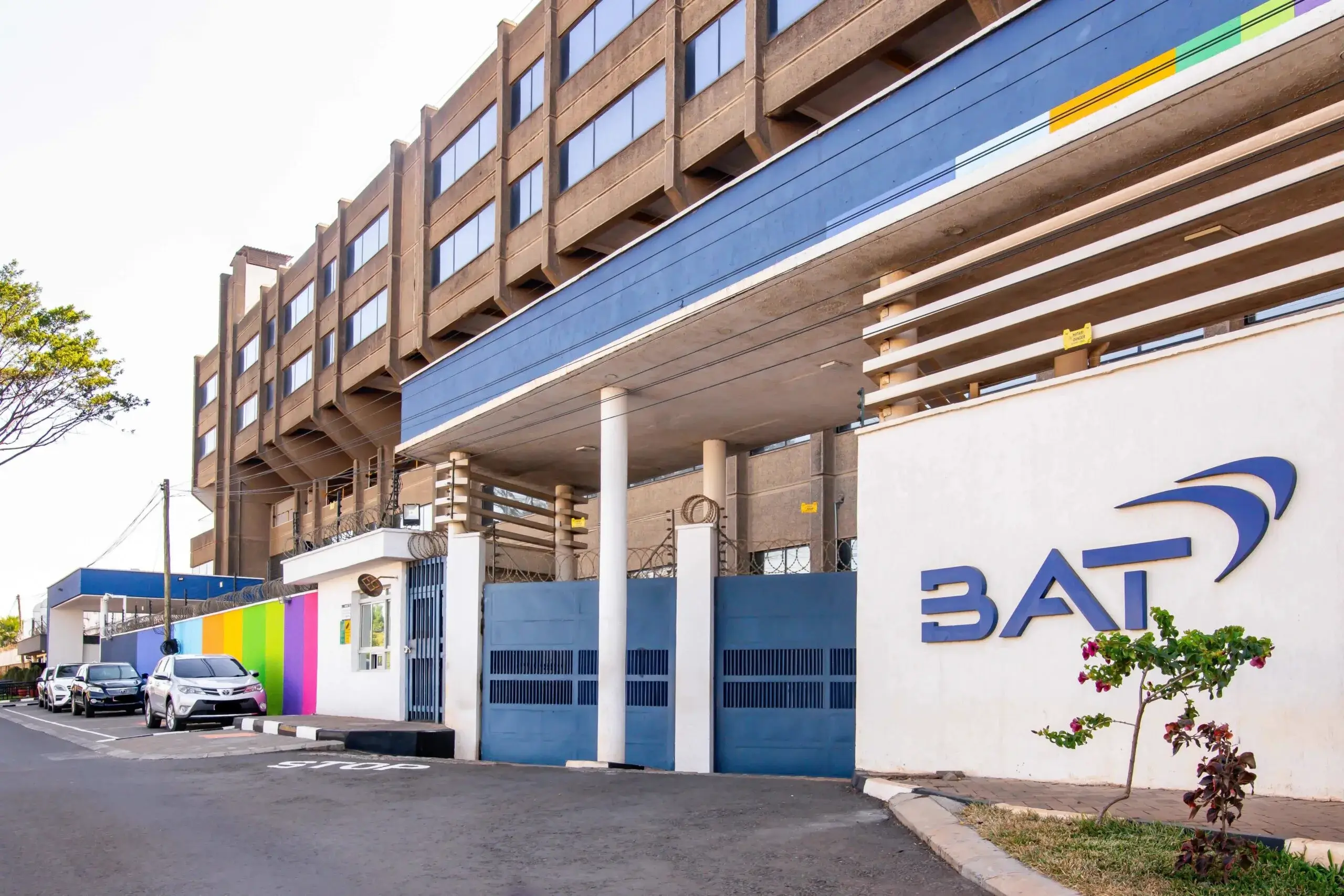
As the cigarette maker rewards shareholders with the highest dividend payout in recent history, the executives who steered it through years of illicit trade headwinds and currency turbulence prepare to step aside.
At a Glance
- KSh 70/share total dividend declared for FY2025 — a 40% increase from KSh 50 in 2024
- Profit before tax rose 18% to KSh 7.7 billion despite a 10% drop in net revenue
- MD Crispin Achola exits June 15, 2026; CFO Philemon Kipkemoi exits March 31, 2026
- Incoming MD Sidney Wafula and incoming CFO Catherine Chepkong'a announced
Just days after declaring a historic total dividend of KSh 70 per share for the financial year ended December 31, 2025, British American Tobacco Kenya PLC (BAT Kenya) has confirmed a sweeping leadership transition at the helm of the company. The board announced that both the Managing Director and the Finance Director will be stepping down, even as the company navigates some of the most complex challenges it has faced in recent memory — foremost among them, an illicit cigarette market that now accounts for nearly half of all domestic cigarette consumption.
The timing of the transition, against the backdrop of record shareholder returns, raises important questions about the company's next chapter: how it will defend its market position, respond to regulatory evolution, and sustain profitability when the structural forces undercutting its revenues show no signs of easing.
The Outgoing Leadership: A Tenure Defined by Resilience
Crispin Achola, who has led BAT Kenya as Managing Director since January 2021, will officially exit on June 15, 2026. His tenure encompassed some of the most turbulent years in the Kenyan tobacco industry, marked by a pandemic-era slowdown, aggressive excise tax hikes, a volatile Kenyan shilling, and an accelerating wave of untaxed and counterfeit cigarettes flooding the domestic market.
Under his watch, BAT Kenya delivered an 18% increase in profit before tax in 2025, rising to KSh 7.7 billion from KSh 6.5 billion the prior year. Despite that robust bottom-line performance, net revenues fell approximately 10% to KSh 23.2 billion — a paradox that tells the story of a company that adapted its cost structure faster than the market eroded its sales volumes. That discipline, widely attributed to Achola's management philosophy, meant the company could still generate meaningful free cash flow even as domestic volumes contracted.
Achola himself acknowledged the mixed environment in his final results commentary. He described illicit cigarettes as the dominant market force locally and regionally, noting their prevalence had jumped from 37% of domestic consumption in 2024 to an estimated 45% in 2025 — a rise that BAT estimates costs the Kenyan government approximately KSh 12 billion annually in lost excise tax revenues. He called for urgently coordinated enforcement action involving stronger border controls, improved market surveillance, and stricter penalties for offenders.
Finance Director Philemon Kipkemoi, who joined BAT Kenya's leadership in 2020, leaves the role at the end of March 2026. His tenure coincided with several demanding cycles for treasury and financial management, including a period of significant Kenyan shilling depreciation and elevated interest rates. Under his stewardship, BAT Kenya ended 2025 with closing cash of KSh 6.2 billion, and the business recorded finance income of KSh 196 million for the year — a dramatic turnaround from an exchange loss position of KSh 800 million in the prior year, reflecting both currency stabilisation and improved cash management practices.
A Record Dividend — and What It Signals
The declaration of a KSh 70 per share total dividend for FY2025 is perhaps the most striking headline from this earnings cycle. It represents a 40% increase from the KSh 50 per share paid in 2024 and translates to a total payout of approximately KSh 7.0 billion — an amount that notably exceeds the company's net profit of KSh 5.25 billion for the year.
The fact that the total dividend payout surpasses net profit is significant. It points to a deliberate decision by the board to distribute expected future cash flows while drawing, at least partially, on the company's retained earnings base. BAT Kenya closed 2025 with retained earnings of KSh 11.86 billion, marginally lower than the KSh 12.07 billion recorded in 2024. For income-focused investors, particularly institutional shareholders, this represents a company confident enough in its medium-term cash generation to be generous with distributions even in a year when revenues declined.
The dividend structure is split between an interim payout of KSh 10 per share — already paid — and a proposed final dividend of KSh 60 per share, subject to shareholder approval at the Annual General Meeting scheduled for June 12, 2026. The final dividend will be paid to shareholders on the company's register as of May 8, 2026.
BAT Kenya: Key Financial Metrics
| Metric | FY2025 | FY2024 |
|---|---|---|
| Net Revenue | KSh 23.2 Billion | KSh 25.7 Billion |
| Profit Before Tax | KSh 7.7 Billion | KSh 6.5 Billion |
| Profit After Tax | KSh 5.25 Billion | KSh 4.48 Billion |
| Total Dividend per Share | KSh 70 | KSh 50 |
| Total Dividend Payout | KSh 7.0 Billion | KSh 5.0 Billion |
| Finance Income / (Loss) | KSh +196 Million | KSh -800 Million |
| Closing Cash | KSh 6.2 Billion | — |
| Illicit Market Share (Domestic) | ~45% | ~37% |
The Incoming Leaders: Who Will Steer BAT Kenya Next?
The board has moved decisively to fill both vacancies from within the BAT Group's existing talent pool, signalling a preference for continuity and institutional familiarity over external disruption.
Sidney Wafula, the incoming Managing Director, is a BAT Kenya veteran. He originally joined BAT Kenya in 2006 and has since built a career across senior finance and operations roles spanning multiple African markets. At the time of the announcement, he serves as Finance Director for BAT's Sub-Saharan Africa Area — a role that gives him both the financial acumen and the regional perspective the incoming MD position demands. His transition into the MD role is effective June 15, 2026, coinciding directly with Achola's departure.
Catherine Chepkong'a steps into the Finance Director role from April 1, 2026 — just one day after Kipkemoi's exit. Having joined the BAT Group in 2012, she brings over a decade of finance leadership experience across East and Southern Africa. Her background in financial governance and performance management is particularly relevant given the complex treasury environment BAT Kenya operates in, with roughly half of its revenues exposed to export markets and the associated foreign exchange dynamics.
The seamless overlap and back-to-back handovers are deliberate. By having the incoming Finance Director start on April 1 while the outgoing MD remains until June, the company creates a short window of parallel leadership — a structure designed to minimise operational disruption during a sensitive financial year.
The Illicit Trade Crisis: BAT Kenya's Defining Challenge
No analysis of BAT Kenya's situation is complete without a thorough examination of what the company describes as its single biggest structural risk: the unchecked growth of the illicit cigarette trade.
The numbers are stark. According to BAT Kenya's own disclosures, citing third-party research, illicit cigarettes now account for an estimated 45% of Kenya's domestic cigarette market — up from 37% in 2024 and from approximately 26% just two years prior. That trajectory represents one of the fastest expansions of illegal tobacco prevalence recorded in any African market in recent years.
The economics driving this phenomenon are well understood. Kenya imposes among the highest excise duties on cigarettes in the region. The resulting price differential between legal, tax-compliant products and untaxed smuggled goods — much of it flowing across the Ugandan border, where excise rates are roughly half those in Kenya — has created a structural incentive for cross-border smuggling at scale. Consumers feeling the squeeze of elevated living costs are particularly receptive to cheaper alternatives, and the two lowest price-point segments of Kenya's cigarette market now account for approximately 70–75% of all domestic consumption.
BAT Kenya estimates that the government loses approximately KSh 12 billion in excise revenues annually due to illicit trade — a figure that has grown from an estimated KSh 9 billion at the half-year stage of 2025. The company has repeatedly called on government agencies to respond with stronger enforcement mechanisms, including tighter border controls, enhanced market surveillance, and stiffer criminal penalties for those caught trading in unregulated tobacco products.
Critically, management has been clear that their strategy to recover domestic volumes does not involve price competition with illicit products. BAT is not planning to cut prices to win back market share — arguing that competing on price with untaxed goods is economically unviable for a compliant operator carrying the full weight of Kenya's excise regime. The more impactful lever, management insists, is enforcement.
The Export Lifeline and Diversification Strategy
One of the most important structural features of BAT Kenya's business model that has cushioned it against domestic volume erosion is its substantial export revenue base. Exports represent approximately half of the company's total revenue — a share that has grown in strategic importance as the domestic market has contracted.
This export orientation gives BAT Kenya significant exposure to markets in the broader East and Central African region, where demand for its products remains more stable. The company's export revenue base also provides a partial natural hedge against domestic market pressures, though it introduces its own currency and logistics complexities.
Beyond traditional cigarettes, BAT Kenya has been advancing its reduced-risk product strategy. The relaunch of oral nicotine pouches in the second half of 2025 represented an important diversification step, though management acknowledged that the contribution from this segment in 2025 was still limited. The company frames this as part of a broader global BAT Group strategy — building a smokeless world through innovative, lower-risk alternatives — while using Kenya as a test market for expanding this portfolio across the region.
What the Transition Means for Investors
For shareholders of BAT Kenya, listed on the Nairobi Securities Exchange, the dual leadership change arrives at a moment of financial strength but structural uncertainty. The record dividend is unambiguously good news for income investors, and the profitability metrics — despite revenue headwinds — demonstrate robust cost discipline. The company closed the year with strong cash reserves, and its retained earnings base provides a buffer for continued distributions.
However, the longer-term revenue trajectory remains vulnerable. If illicit trade penetration continues to climb — from 45% toward 50% of the domestic market — the pressure on net revenues will intensify. Cost optimisation can only go so far in compensating for volume declines; at some point, structural revenue erosion begins to undermine the earnings base itself.
The incoming leadership team will need to manage a delicate balance: maintaining the shareholder value commitment that has defined BAT Kenya's investment case, while navigating an operating environment that demands both regulatory engagement and commercial innovation. Wafula's deep familiarity with BAT Kenya's financials and operations, combined with Chepkong'a's regional governance experience, suggests the board has chosen stability over transformation — a calculated bet that the company's current strategic direction is sound, and that what is needed is execution rather than reinvention.
The Broader Industry Context
BAT Kenya's challenges are not unique to the company or even the country. Across sub-Saharan Africa, tobacco manufacturers operating within formal regulatory frameworks are contending with the dual pressures of rising illicit competition and shifting consumer behaviour as disposable incomes remain constrained by persistent inflation and currency weakness.
The Kenyan government faces a genuine policy dilemma. The excise tax revenue collected from legal tobacco sales forms a meaningful component of public finances, and yet the very level of taxation that makes those revenues significant also creates the price gap that fuels smuggling. BAT Kenya has been vocal in arguing that the solution is not lower taxes — but better enforcement that protects the tax base by ensuring more transactions occur within the legal framework.
Whether Kenya's regulatory and enforcement agencies can mobilise the institutional capacity to meaningfully disrupt cross-border tobacco smuggling networks remains an open question. The answer will do much to determine how quickly — if at all — BAT Kenya can recover its domestic revenue trajectory.
Conclusion: End of an Era, Beginning of a Test
The departure of Crispin Achola and Philemon Kipkemoi marks the end of a leadership era at BAT Kenya — one characterised by careful navigation of a genuinely difficult operating environment. The record KSh 70 dividend they leave behind is, in many ways, a summary statement of what they achieved: a company that preserved its financial strength and rewarded its shareholders even as the ground shifted beneath it.
The incoming team of Sidney Wafula and Catherine Chepkong'a inherits a business in good financial health but facing a structural threat that no internal management decision alone can resolve. The illicit cigarette crisis is as much a public policy problem as a commercial one, and BAT Kenya's fortunes will partly depend on forces outside its direct control.
What the company can control is how it manages its export relationships, how quickly it builds out its reduced-risk product portfolio, and how effectively it engages with government and regulators to make the case for stronger enforcement. On those fronts, the new leadership team will face its first test — and the market will be watching closely.